
Staying Informed on Business-Side Progress Without Managing It: A Guide for Immigration Attorneys

Investor and entrepreneur immigration matters often depend on documents the attorney does not produce. A business plan, entity formation records, or proof of a business checking account may be part of the evidence plan, and those pieces typically come from the client or from a provider the client hires. Many attorneys end up chasing them anyway, because a late or incomplete business document can hold up the filing they are responsible for.
This article explains how an attorney can stay informed on business-side progress in E-2, L-1, EB-5, and EB-2 NIW matters without taking on the coordination work. It covers which business-side components may be relevant, where attorneys tend to lose time, what a workable visibility arrangement looks like, and how Immigration Support Services (ISS) fits alongside your practice.
Why business-side components stall legal timelines
In investor and entrepreneur cases, the attorney controls the legal strategy and the filing, but usually not the inputs that feed it. Depending on the visa category, the case facts, and the attorney’s evidence plan, a client may need a written business plan, a registered entity with an EIN, or a U.S. business checking account. Which of these matter, and in what form, is a legal judgment that belongs to the attorney. Each component that is needed involves a different provider, a different intake process, and a different set of client homework.
When no one is coordinating those pieces, the attorney becomes the default coordinator. Paralegals send reminder emails about the business plan draft. The client asks the attorney which document the formation provider needs next. Weeks pass while a checking account application sits waiting on a missing document that nobody flagged.
None of that is legal work, but it consumes legal time. The goal is not to eliminate the attorney’s visibility into the business side. It is to separate visibility from management, so you know where things stand without being the person moving them forward.
What attorneys actually need to know, and when
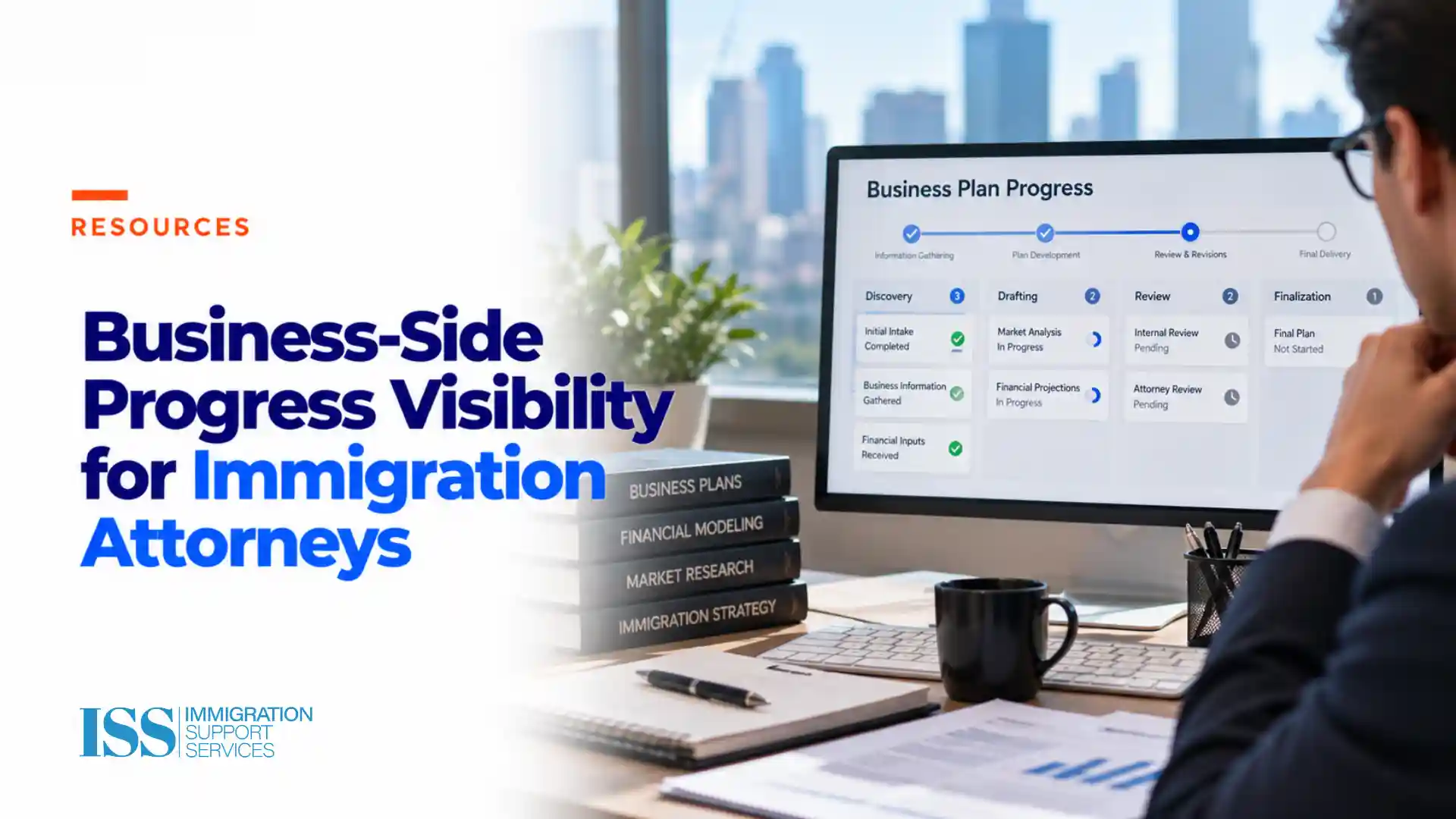
Most attorneys do not need a daily update on a business plan. They need a small number of status points that affect the legal timeline. In practice, these tend to be the handful of moments listed below.
- Intake complete: the client has submitted the documents and questionnaire the provider needs to start.
- Work in progress: the first draft or initial filing has started, and the attorney can plan the filing timeline around an expected window.
- Client review stage: the client has a draft to review, and the attorney may want to look at it for consistency with the legal narrative.
- Deliverable complete: the final business plan, the entity formation documents and EIN assignment or verification documentation, or the checking account application outcome is in hand.
Everything between those points is coordination detail. If an attorney has clear notice at each of those stages, the business side rarely surprises the legal side.
The consistency check belongs with the attorney
One point of attorney involvement is worth keeping: reviewing the business plan draft for consistency with the petition narrative. Whether a plan meets the requirements of a particular visa category is a legal question, and it stays with the attorney. ISS does not assess sufficiency, and nothing in this article should be read as suggesting that a business plan or any other document satisfies USCIS requirements.
What a coordinated process can do is make sure the draft reaches the client, and the attorney where the client has arranged for that, at the right stage, with revisions still available, so that review happens before the design phase rather than after.
A workable model: coordinated fulfillment with attorney visibility
The arrangement that tends to work is simple. The client signs with a business support services company that coordinates the business-side pieces. The client, the attorney, and the provider agree at the outset on which milestones the attorney wants to know about and how that information will be shared. The attorney remains responsible for all legal strategy and filings. The client has one point of contact for business-side questions, which keeps those questions out of the attorney’s inbox.
This is the model ISS is built around. ISS coordinates the business-side services commonly needed in investor and entrepreneur immigration matters, business plan, entity registration, and business checking account assistance, in one place. ISS works alongside referring counsel, who remains responsible for all legal strategy and filings; we handle the business-side pieces.
How the dedicated coordinator fits
For immigration business plans and business checking account application assistance, a dedicated ISS coordinator guides the client through the process from start to finish. The coordinator collects intake materials and keeps the client on task. Where the client wants their attorney kept informed, the client can raise that at intake so the handoff points can be agreed on at the start of the engagement. The business plan itself is prepared by professional business plan writers experienced in immigration-related documentation, through ISS, with unlimited revisions until the design phase. The first draft is typically delivered within 7 to 10 business days after the client submits all required documents and the intake questionnaire. Details of what the plan typically includes are on the ISS immigration business plan service page.
Entity registration works differently, and the distinction matters for how you set expectations with a client. ISS signs the client and introduces them to a document-filing provider, who then works with the client directly to register an LLC or corporation in the state the client selects and to apply for an EIN with the IRS. State filing fees are additional. The client, with their attorney, is solely responsible for choosing the entity type, the state of formation, and the ownership structure; ISS does not advise on those choices. The ISS business entity registration service page describes how the introduction works.
Setting up the information flow at referral
The visibility arrangement works best when it is defined at the moment of referral rather than reconstructed mid-engagement. A few practices make the difference.
Agree on who receives updates
Decide at the outset whether business-side status information should reach the attorney, a paralegal, or a shared case inbox, and have the client confirm that preference with the provider. Business-side milestones are easier to track when they land in the same place the legal team already monitors. If the client wants the attorney to see the business plan draft before it is finalized, that preference should be stated early so the review step is built into the revision cycle.
Define the handoff points
Be explicit about what the attorney needs and in what form: the final business plan as a PDF, the articles of organization or incorporation, the EIN assignment or verification documentation, the checking account documentation. When the deliverable list is known from the start, the client is not asked twice for the same material and the attorney is not left guessing what has been completed.
Keep legal questions routed to the attorney
Clients working on the business side will ask legal-adjacent questions: whether their investment amount is enough, whether they should form in one state or another, whether a particular business model fits the visa category. ISS coordinators do not answer those questions. They direct the client back to the attorney. That routing helps preserve the division between business-side coordination and the attorney’s legal role, so the provider is not drifting into advice that conflicts with the legal strategy.
What this looks like in practice
Consider an illustrative E-2 matter in which the attorney has determined that the client needs a business plan, a newly formed entity, and a business checking account. After the attorney refers the client to ISS, the client signs an ISS agreement and completes the intake questionnaire. The client, the attorney, and ISS can establish agreed handoff points at the start of the engagement, which gives the attorney reference points for planning the filing.
As the business plan draft is prepared, the coordinator keeps the client responsive to writer questions. When the draft is ready, the client reviews it, and the attorney reviews it for consistency with the petition narrative where that has been arranged. Revisions proceed until the client is satisfied, up to the design phase. Meanwhile, the client is working directly with the document-filing provider on entity registration, and the coordinator assists with the checking account application once the documents required by the account provider are available. The attorney spends their time on the legal work.
In this arrangement, the attorney can reduce the time spent sending reminder emails about business documents. That is the difference between staying informed and managing.
Why attorneys refer to ISS
ISS has been serving clients since 2022. ISS has completed more than 575 immigration business plans and more than 240 business entity registrations, and has assisted with more than 140 business checking account applications. These figures give referring attorneys an operating record to evaluate, alongside a 4.9-star average across more than 100 Google reviews. Every case is different and prior results do not guarantee a similar outcome.
The checking account service is also useful for clients who are still abroad. The client does not need to be physically present in the U.S. to apply, and the service is available to founders from most countries. The account provider is a financial technology company, not a bank, and the provider makes the final decision on each application; ISS does not provide banking services and cannot guarantee that an account will be opened. See the ISS business checking account application assistance page for how the application assistance works.
A note on the referral program
ISS offers a referral program for collaborating attorneys, and referral compensation may be available, structured transparently. Specific terms are discussed directly with the ISS collaboration manager and set out in the referral agreement. Attorneys are solely responsible for ensuring any referral arrangement complies with the professional responsibility rules of their jurisdiction, including any required client disclosure and consent. ISS does not advise attorneys on their ethical obligations, and nothing here should be read as a statement that the arrangement is permissible in any particular jurisdiction.
Frequently asked questions
Does ISS send status updates directly to the referring attorney?
ISS works with the client under an ISS agreement, so the client decides who is kept informed. If the client wants their attorney to receive business-side status information, that preference can be raised at intake so that handoff points are agreed on at the start of the engagement.
Does ISS review the business plan for visa eligibility or sufficiency?
No. The business plan is a supporting document prepared from client-provided information by professional business plan writers through ISS. Whether it meets the requirements of any visa category is a legal question for the client and their attorney, and ISS does not assess sufficiency.
Can a client who is still outside the U.S. use the checking account service?
Yes, the client does not need to be physically present in the U.S. to apply, and the service is available to founders from most countries. The account provider, a financial technology company rather than a bank, makes the final decision on each application, so ISS cannot guarantee that an account will be opened.
Does referring a client to ISS change the attorney’s role in the matter?
No. The attorney remains responsible for all legal strategy and filings, and ISS coordinators route legal questions back to counsel. Attorneys remain solely responsible for confirming that any referral arrangement complies with the professional responsibility rules of their jurisdiction.
Conclusion
Attorneys handling investor and entrepreneur matters do not need to run the business side to stay informed about it. A defined set of milestones agreed on at the outset, a clear handoff list, and a coordinated provider that routes legal questions back to counsel give the attorney the visibility they need while keeping the coordination work off their desk. ISS was set up to fill exactly that role: business-side fulfillment that works alongside the attorney, never in place of one.
If you would like to discuss how ISS coordinates business-side components for your clients, schedule a consultation now. The routing form on that page will direct you to the attorney calendar.