

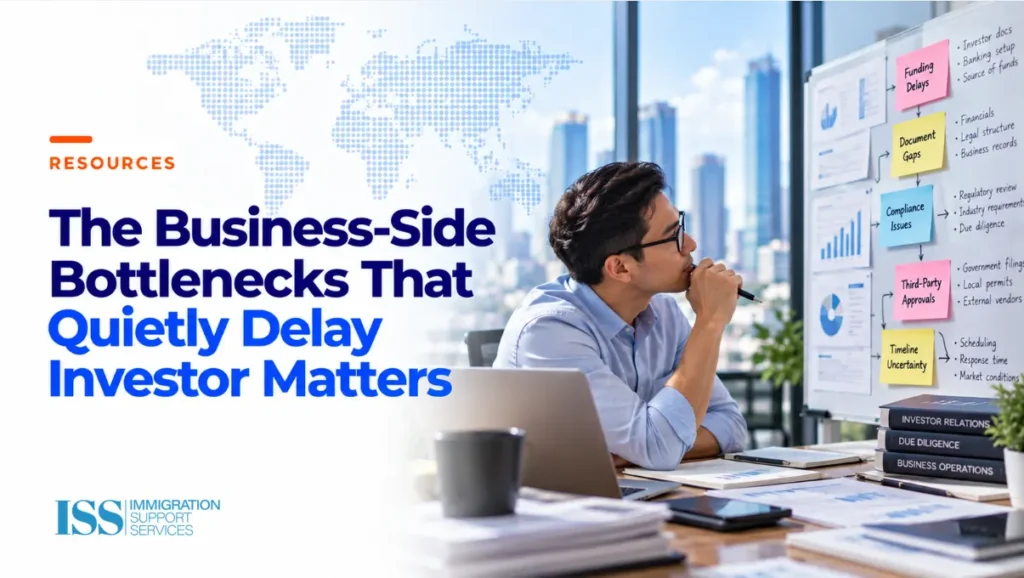
Most people preparing an investor or entrepreneur immigration case expect the legal work to take time. What catches many of them off guard is how often the delay comes from somewhere else: a business plan that is still in draft, an entity that has not been registered, a checking account application that stalled, or a stack of documents that never quite got organized. These are business-side tasks, not legal ones, and they tend to slip because nobody owns them clearly.
This article walks through the business-side bottlenecks that commonly slow down E-2, L-1, EB-5, and EB-2 NIW matters, explains why each one causes delay, and describes what an organized approach looks like. It does not tell you which visa category fits your situation or whether your documents meet any legal standard. Those are questions for a licensed immigration attorney. The goal here is simply to help you see the business-side work coming so it does not become the reason your case waits.
Why the business side matters in investor and entrepreneur cases
Investor and entrepreneur visa categories are built around a real business, though each one is built differently. The E-2 visa generally involves a substantial investment in a U.S. enterprise by a national of a treaty country. The L-1 visa generally involves transferring a manager, executive, or specialized-knowledge employee from a foreign organization to a U.S. organization that has a qualifying relationship with it (such as a parent, subsidiary, branch, or affiliate), and it generally requires a qualifying period of continuous employment with the foreign organization before the petition. The EB-5 program, as USCIS describes it, requires the necessary investment in a U.S. commercial enterprise and a plan to create or preserve a required number of permanent full-time jobs for qualifying U.S. workers. The EB-2 NIW requires that the applicant first qualify for the EB-2 classification and then satisfy the national interest waiver framework, which looks at a proposed endeavor’s merit and national importance, among other factors. Each category has its own legal requirements, and only an attorney can tell you how they apply to your facts.
These categories do not all turn on company formation or committed funds. E-2, L-1, and EB-5 filings commonly rely on business documentation: evidence of the U.S. enterprise, of funds committed or ready to be committed, and of a plan for operating the business. For an entrepreneur pursuing an EB-2 NIW, a business plan may be one relevant piece of evidence among others, but no single document establishes eligibility. In any of these categories, missing or inconsistent business documents can keep the attorney from finalizing the petition or application, no matter how far along the legal analysis is.
Bottleneck 1: The business plan that is never quite finished
The immigration business plan can sit on the critical path. In many investor and entrepreneur matters, the attorney wants the plan in hand before assembling the final filing package, because the plan ties together the company description, the market, the management team, the hiring projections, and the financial projections. If the plan is late, the filing often waits.
Plans run late for predictable reasons. The applicant tries to write it alone while also running the investment, raising capital, and relocating. Financial projections get built on assumptions that change every week. Or the plan is written as a general startup pitch rather than as a document structured for an immigration filing, and it has to be reworked after the attorney reviews it.
An immigration business plan prepared through ISS typically includes a company presentation, products and services, management, industry and competition analysis, a market study, a marketing and sales plan, and five-year financial projections. It comes with unlimited revisions until the design phase, and the first draft is typically delivered within 7 to 10 business days after all required documents and the intake questionnaire are submitted. That timeline depends entirely on the condition attached to it: the clock does not start until the inputs are complete. Whether any plan satisfies the requirements of a particular visa category is a question for your attorney, not for ISS.
What usually slows down the plan itself
Gathering the required inputs can take significant time: a clear description of the business model, a realistic budget, information about the owner’s background, and the numbers behind the projections. If you are at the beginning of the process, assembling that material early is one of the most useful things you can do, whoever ends up preparing the plan.
Bottleneck 2: The entity that has not been registered
Many investor and entrepreneur filings reference a specific U.S. entity. The business plan describes that entity. The checking account is opened in that entity’s name. Leases, contracts, and invoices are often executed by that entity. When registration has not happened yet, the rest of the business documentation has nothing to attach to, and every downstream task waits.
Registration itself is a defined administrative process: filing formation documents with the chosen state and then applying for an Employer Identification Number (EIN) with the IRS. The entity is formed with the state first, and the EIN application follows, since the IRS asks for the entity’s formation details. Applicants outside the United States who cannot use the IRS online application may need to apply through another IRS method, which can add time. The delay usually comes earlier, though, when the applicant has not yet decided on the entity type, the state of formation, or the ownership structure. Those decisions belong to you and your attorney (and, where relevant, your tax advisor). ISS does not advise on which entity type, state, or structure to choose, and nothing in this article should be read as a recommendation.
Once those decisions are made, ISS can facilitate your entity registration through a document-filing provider. ISS signs the engagement and introduces you to the provider, who then works with you directly to complete the state filing and the EIN application. State filing fees are charged by the state and are additional. The state, not ISS or the provider, controls whether and when a registration is accepted, so timing is never guaranteed.
Bottleneck 3: The checking account that stalls
A U.S. business checking account is often where investment funds land, and attorneys frequently want to document the transfer of funds into the enterprise. Opening that account from outside the United States has historically been one of the more frustrating steps for founders. Traditional institutions may require in-person visits, U.S. identification, or an established U.S. history that a new arrival simply does not have.
A delayed checking account application can affect how funds are transferred and documented. It is an operational bottleneck rather than a legal requirement: a checking account is not the only way an investment can be documented, and USCIS materials refer to other forms of evidence as well. Your attorney determines what investment evidence is needed in your matter and when the matter is ready to file.
ISS assists with the application to open a U.S. business checking account for your entity. You do not need to be physically present in the U.S., and the service is available to founders from most countries. The account provider is a financial technology company, not a bank; ISS provides no banking services and is not affiliated with any bank. The provider makes the decision on every application, so ISS cannot guarantee an account will be opened. ISS can assist you with preparing and submitting the checking account application, while the provider controls its review and decision.
Bottleneck 4: Documents that exist but are not organized
The fourth bottleneck is less visible than the first three because nothing is technically missing. The company is registered, the account is open, the plan is drafted. But the formation documents are in one email thread, the EIN confirmation is in a different inbox, the account statements are in a portal nobody remembers the password to, and the business plan’s financial projections no longer match the budget on the account.
Attorneys and paralegals spend real hours reconciling this kind of material, and every inconsistency generates a question back to the client. Multiply that across several documents and the filing can be delayed. Keeping a single organized folder with the current version of each business document, clearly dated, is a simple habit that reduces this friction considerably.
Bottleneck 5: Sequencing the work in the wrong order
Each of the tasks above can depend on another. The checking account needs the entity. The business plan needs the entity name, the ownership structure, and a realistic picture of how funds will be used. Your attorney may need some or all of these materials, depending on the visa category, your business model, where the matter stands procedurally, and case strategy. When these tasks are started in parallel without coordination, or in the wrong order, the result is rework: a plan written for an entity that is later restructured, or an account application submitted before the EIN is issued.
Ask your attorney to establish the sequence for legal strategy, entity decisions, registration, the EIN, the checking account application, and the business plan based on your matter. Once that sequence is set, the business-side tasks can be started in the right order, and the people handling them know what they are waiting on and what is waiting on them.
What an organized business-side process looks like
The common thread across all five bottlenecks is ownership. Legal work has a clear owner: your attorney. Business-side work often does not, and tasks that nobody owns are the ones that drift. The fix is not complicated. It is deciding, early, who is responsible for each business-side deliverable, what inputs they need, and when the attorney expects to receive it.
This is the role ISS was built for. ISS coordinates the business-side services commonly needed in investor and entrepreneur immigration matters, the business plan, entity registration, and business checking account assistance, in one place. For business plans and checking account assistance, a dedicated ISS coordinator guides you through the process from start to finish. For entity registration, ISS introduces you to the document-filing provider, who works with you directly. Throughout, ISS works alongside your immigration attorney, who remains responsible for all legal strategy and filings; we handle the business-side pieces.
Since 2022, more than 575 immigration business plans have been completed through ISS, along with more than 240 business entity registrations completed and more than 140 business checking account applications assisted. Every case is different and prior results do not guarantee a similar outcome. Business plans and related documents are supporting documents prepared from client-provided information; whether any document meets immigration requirements is a question for you and your attorney.
Frequently asked questions
-
- Does ISS tell me which visa category or entity type to choose?
- No. Visa category, entity type, state of formation, and ownership structure are legal and business decisions that belong to you and your licensed immigration attorney, with input from a tax advisor where relevant. ISS does not provide legal advice, and nothing in this article recommends a category or a structure.
-
- Do I need to be in the United States to apply for the business checking account?
- No. ISS assists with the application remotely, and physical presence in the U.S. is not required. The account provider is a financial technology company, not a bank, and it decides every application, so availability is qualified: the service is available to founders from most countries, and no account opening is guaranteed.
-
- How long does the immigration business plan take?
- The first draft is typically delivered within 7 to 10 business days after all required documents and the intake questionnaire are submitted. That timeline is conditional on complete inputs, which is why gathering your business description, budget, and background information early matters. Revisions are unlimited until the design phase.
-
- I already have an immigration attorney. Where does ISS fit?
- ISS works alongside your attorney, who remains responsible for all legal strategy and filings. ISS coordinates the business-side pieces: the business plan, entity registration, and the checking account application. You are never required to use ISS to work with any attorney, and hiring ISS does not provide legal representation.
Conclusion
Investor and entrepreneur matters rarely stall because of a single dramatic problem. They stall because of several small, unowned business-side tasks: an unfinished plan, an unregistered entity, a checking account application that never moved, a disorganized document set, or work done in the wrong order. Seeing those bottlenecks early, assigning clear ownership, and sequencing the work with your attorney’s guidance can help reduce business-side delays.
If you would like help organizing the business-side pieces of your matter, you can schedule a consultation now. We will walk through where you are in the process and which services, if any, fit what you need. Legal questions about eligibility, strategy, or requirements should go to your licensed immigration attorney.
Immigration Support Services Inc. is not a law firm and does not provide legal advice or legal representation. The information in this article is for general educational purposes only. Immigration laws change frequently, and legal questions should be directed to a licensed immigration attorney.