

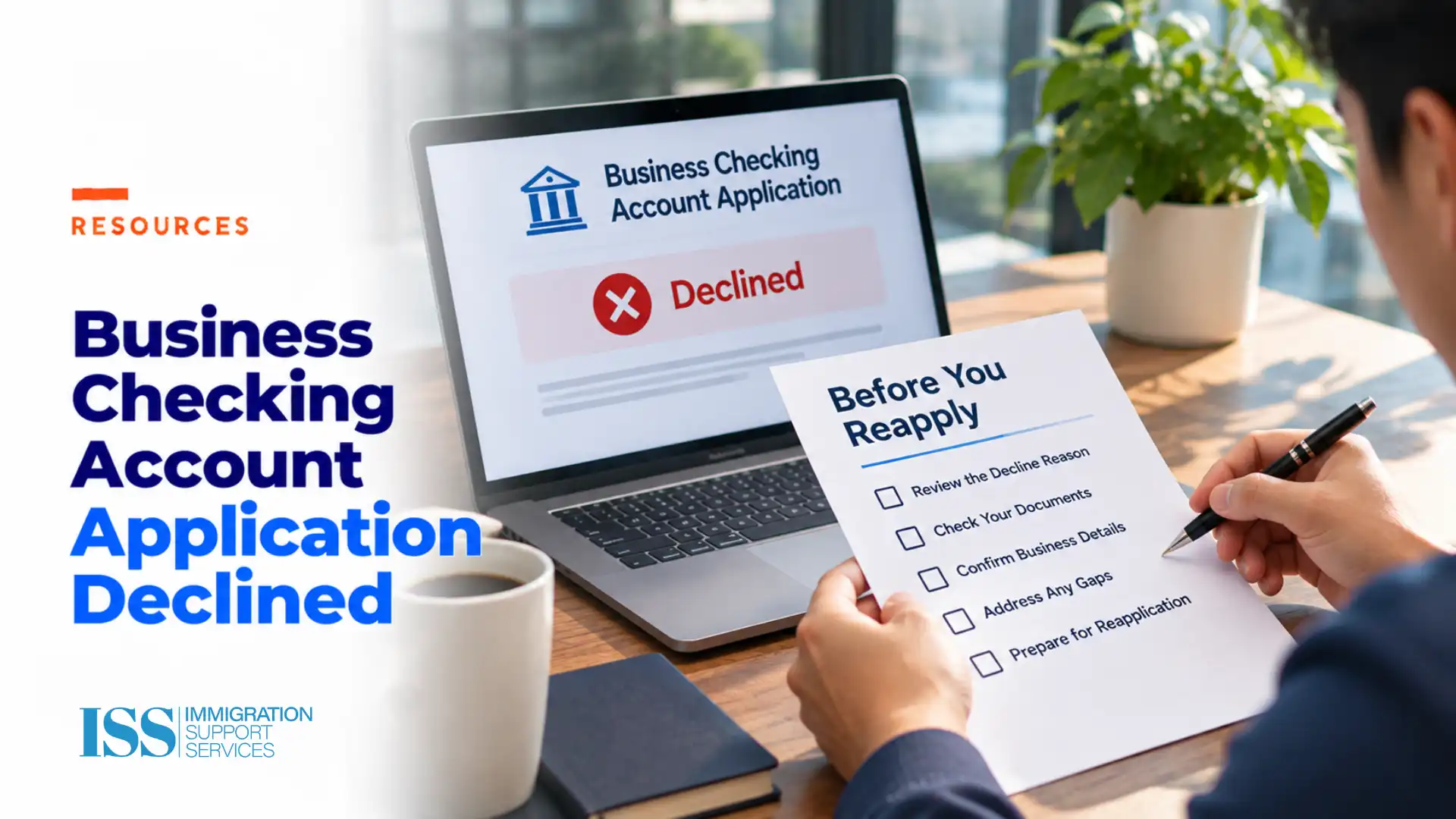
Having a business checking account application declined is frustrating, especially when the account is one of the pieces you need in place for a business or investment immigration matter. The good news is that a decline often traces back to something practical in the application itself rather than to the business idea. This article walks through the reasons applications can be declined, what you can review on your end before applying again, and how to approach a second application in an organized way.
One point up front: account providers make their own decisions, and no one outside the provider can promise that a second application will be approved. What you can do is remove the avoidable problems so your application is as complete and consistent as possible.
Why business checking account applications get declined
Regulated financial institutions in the United States are required to verify who they are doing business with. These identity and ownership checks are commonly described as “Know Your Customer” or customer identification requirements. A financial technology company that offers business checking accounts typically does so through a partner financial institution subject to these rules, so the same verification standards apply to the application you submit. When an application can’t be verified cleanly, it may be declined rather than returned with a request for more information.
The provider usually doesn’t explain the specific reason in detail. That leaves applicants guessing. Possible reasons fall into a handful of categories: entity documentation that is incomplete or not yet finalized, information that doesn’t match across documents, identity verification issues for the owners, business activity or location that falls outside the provider’s eligibility rules, or a data entry mistake.
The sections below cover each category and what to check.
Check 1: Is your business entity fully formed and documented?
Applications are sometimes submitted before the entity paperwork is actually complete. A provider will generally expect to see that the LLC or corporation has been registered with the state and that formation documents are available. If the state hasn’t yet approved the filing, or if you only have a receipt rather than the state-issued formation document the provider asks for, the application may not pass review.
Before reapplying, gather the final documents for your entity: the state-approved formation document (often called Articles of Organization for an LLC or Articles of Incorporation for a corporation), any operating agreement or bylaws if the provider requests them, and confirmation that the entity is listed as active in the state’s business records. If the state shows the entity as pending, inactive, or not found, that needs to be resolved first.
If your entity hasn’t been registered yet, that’s the starting point. ISS facilitates entity registration through a document-filing provider; details are on the ISS business entity registration service page. Which entity type, state, and ownership structure to use are decisions for you and your immigration attorney; ISS does not advise on those choices.
Check 2: Has your EIN been issued, and does it match?
An Employer Identification Number (EIN) from the IRS is commonly required for a U.S. business checking account. Two problems come up repeatedly. The first is applying for the account before the EIN has actually been issued. The second is an EIN that was issued but is tied to a business name or address that differs from what was entered in the account application.
Locate your IRS EIN documentation. Depending on how and when you applied, this may be a CP 575 notice, a digital EIN verification notice, or a Letter 147C obtained from the IRS later. Compare it line by line to your formation documents and your account application. The legal business name, including punctuation and the entity designation such as “LLC” or “Inc.”, should match exactly.
If the EIN record contains a typo or an outdated business name, the IRS publishes procedures for updating business name records, and the steps vary by entity type and filing status. Some changes in ownership or structure can require a new EIN rather than a correction to the existing record. Check the current IRS guidance, or ask your tax professional, and complete any correction before you apply again.
Check 3: Does the information match across every document?
Inconsistency is one of the most avoidable reasons for a decline. Providers compare the details you enter against the documents you upload and against outside records. Small mismatches that seem harmless to you can cause an automated review to fail.
Go through the following and confirm each item is identical everywhere it appears:
- Legal business name, including spelling, spacing, and the entity suffix.
- Business address, written the same way on the state filing, the EIN record, and the application.
- Owner names, exactly as they appear on passports or other government-issued identification.
- Dates of birth and identification numbers for each owner.
- Ownership percentages, which should align with your operating agreement or share records.
If you find a discrepancy, decide which document is correct and fix the others before reapplying. Submitting a new application with the same mismatch is likely to produce the same result.
Check 4: Can each owner’s identity be verified?
Providers are generally required to identify the individuals who own or control the business, often referred to as beneficial owners. For a founder who is outside the United States, this step depends heavily on the quality of the identity documents submitted.
Review the following before a second attempt. Your passport should be valid, and if the provider sets a minimum remaining validity period, it should meet that requirement. The scan or photo should be clear, in color, with all four corners visible and no glare across the photo or data page. If the provider asked for a selfie or live verification step, make sure it was completed on a device and connection that allowed it to finish. If a proof-of-address document is requested, it should be as recent as the provider requires and show the same name as the passport.
If any owner’s identity verification failed, the entire application can be declined even when the business documents were perfect. Each person listed as an owner or controlling person should be ready to complete verification promptly when the new application is submitted.
Check 5: Does your business fall within the provider’s eligibility rules?
Every account provider maintains its own list of eligible countries, business types, and industries. These lists are set by the provider based on its own compliance obligations and risk policies. An application can be declined simply because the founder’s country of residence or citizenship is not on the provider’s eligible list, or because the business activity falls into a restricted category.
Restricted categories at many providers include money services, cryptocurrency exchanges, gambling, adult content, cannabis, and certain import-export activities involving sanctioned countries. If your business operates in or near one of these areas, the decline may reflect the provider’s policy rather than anything you can fix in the paperwork. In that case, a different provider may be the realistic path, and your business description should be accurate and specific so the provider can assess it correctly.
Business checking account application assistance through ISS is available to founders from most countries, with the understanding that eligibility restrictions exist for certain countries and the provider makes the final decision.
Check 6: Is your business description clear and consistent with your plan?
Providers usually ask what the business does, where it operates, how it generates revenue, and what the expected transaction activity looks like. Vague or inconsistent answers can raise questions. A description that says “consulting” on the application while the website or business plan describes a restaurant is the type of mismatch that can lead to a decline.
Write a short, plain description of the business that matches your formation documents, your website if you have one, and your immigration business plan if one has been prepared. If your business plan describes projected revenue and the account application asks for expected monthly volume, those figures should be in the same general range. A well-prepared business plan can be a useful reference here because it already organizes the company presentation, products or services, and financial projections in one place. You can read more about what an ISS immigration business plan includes on the ISS immigration business plan service page.
Check 7: Was the application itself completed correctly?
It sounds basic, but data entry errors can cause a decline on their own. A transposed digit in the EIN, a wrong formation date, a missing apartment number in an address, or selecting the wrong entity type from a dropdown can all cause verification to fail. Some applications also time out if left incomplete, and an abandoned application can register as a declined one.
Before reapplying, print or save a copy of each document you intend to upload and work from those documents as you type. Have one person complete the application in a single session if possible, and double-check every field before submitting.
Reapplying: timing and approach
After a decline, resist the urge to immediately resubmit the same information. Some providers require a waiting period before a new application can be submitted, and resubmitting unchanged data rarely produces a different outcome. Use the time to complete the checks above and correct anything that was wrong.
If the provider offered any explanation, however brief, take it at face value and address that item first. If the provider gave no explanation, work through the checklist in order, since entity documentation, the EIN, and identity verification are the foundation of the review. Keep a simple record of what you changed between the first and second applications so that, if a second decline happens, you can narrow down what remains.
If you are working with an immigration attorney, let them know about the decline. The checking account is often connected to a broader timeline for your immigration matter, and your attorney is the right person to advise on how a delay affects your case and whether anything in your filing strategy should change. ISS does not provide that advice.
How ISS can help with the application
ISS assists clients with business checking account applications for their U.S. entities, and physical presence in the United States is not required. A dedicated ISS coordinator guides you through the process from start to finish, helping you gather requested documents and check the information for consistency as you prepare your application. The account provider is a financial technology company, not a bank; ISS does not provide banking services and is not affiliated with any bank, and the provider makes the final decision on every application.
ISS also coordinates the related business-side pieces that frequently come up in the same matter, including business entity registration and immigration business plans commonly used to support E-2, L-1, and EB-5 cases. Every case is different and prior results do not guarantee a similar outcome. ISS works alongside your immigration attorney, who remains responsible for all legal strategy and filings; we handle the business-side pieces. Details are on the ISS business checking account application assistance service page.
Frequently asked questions
Will the provider tell me why my application was declined?
Usually not in detail. Many providers send a short notice that the application could not be approved and, for compliance reasons, do not list the specific trigger. That is why reviewing your own documentation, identity verification, and eligibility fit is the practical way to find the issue before you try again.
How long should I wait before reapplying?
It depends on the provider. Some set a waiting period before a new application can be submitted, and others allow a new application once the earlier one is closed. Check the provider’s terms or decline notice, and use whatever time you have to correct the problems you find rather than resubmitting the same information.
Can I apply with a different provider instead of reapplying with the same one?
Yes. If the decline appears to be tied to the provider’s eligibility rules, such as the founder’s country or the business’s industry, a different provider may be the realistic option. Keep in mind that each provider has its own rules and makes its own decisions, so the same document review applies wherever you apply.
Does a declined checking account application affect my immigration case?
That is a question for your immigration attorney. A checking account is often one piece of a broader timeline in an investor or entrepreneur immigration matter, and only your attorney can tell you how a delay affects your specific case or strategy. ISS can help you organize the business-side pieces, but it does not provide legal advice.
Do I need to be in the United States to reapply?
No. Physical presence in the United States is not required for the business checking account application assistance ISS provides. Identity verification is completed remotely, and availability is subject to the provider’s eligibility rules, which restrict certain countries.
Conclusion
A declined business checking account application is usually a signal that something in the documentation, identity verification, or eligibility review did not line up, not a final judgment on your business. Confirm your entity is fully formed and active, make sure your EIN has been issued and matches your records, verify that every detail is consistent across documents, prepare clear identity documents for each owner, confirm your business falls within the provider’s eligibility rules, and complete the application carefully. Then reapply with a clean, consistent package.
If you would like help organizing a second application, schedule a consultation with ISS and a member of our team will walk through where things stand and how we can assist.
Immigration Support Services Inc. is not a law firm and does not provide legal advice or legal representation. The information in this article is for general educational purposes only. Immigration laws change frequently, and legal questions should be directed to a licensed immigration attorney.