

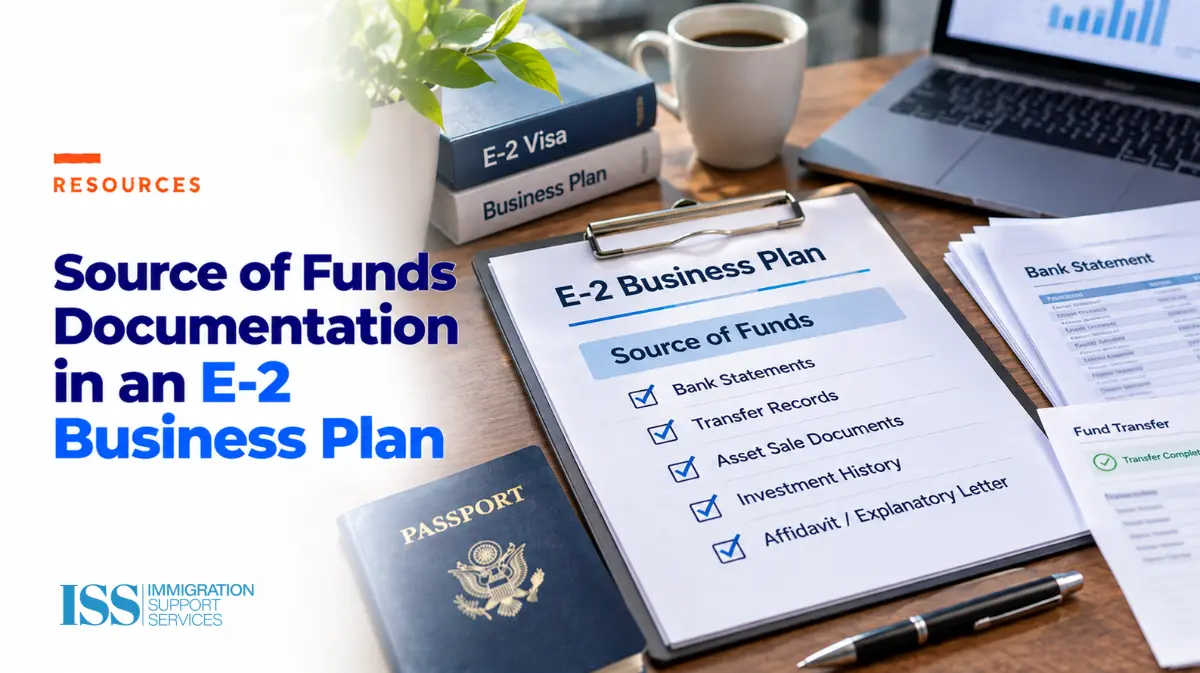
Most people preparing for an E-2 treaty investor case expect to prove they invested money in a U.S. business. Fewer expect the source and movement of that money to be examined in detail, or that the paper trail needs to line up with what the business plan says. This article covers what E-2 source of funds documentation generally means, what kinds of records are commonly used, and how that documentation typically connects to the investment and use-of-funds sections of an E-2 business plan.
This is an educational overview of what the rules generally provide. Whether your funds, your records, or your investment meet the requirements of the E-2 classification is a legal question for a licensed immigration attorney.
Why source of funds matters in an E-2 case
The E-2 classification is available to nationals of treaty countries who have invested, or are actively in the process of investing, a substantial amount of capital in a bona fide U.S. enterprise. The regulations at 8 CFR 214.2(e) and the Department of State’s Foreign Affairs Manual at 9 FAM 402.9 describe what counts as an investment. In general terms, the investor must possess and control the capital, and the capital must be placed at risk in the commercial sense: it is irrevocably committed to the enterprise and subject to partial or total loss if the venture fails. There is no fixed dollar minimum that makes an investment substantial. The Foreign Affairs Manual describes a proportionality test that compares the amount invested with the cost of purchasing or establishing the particular business.
Those general requirements are why source of funds documentation exists. The authorities also provide that the capital must not have been obtained, directly or indirectly, from criminal activity. An adjudicator reviewing the case generally wants to see where the funds came from, that the investor possesses and controls them, and that they have in fact been committed to the enterprise. A business plan that describes a well-funded company is not persuasive on its own. The documents behind it carry the weight.
An attorney will typically frame the case around three questions: where did the money come from, does the investor possess and control it, and has it been committed to the business? The rest of this article walks through what the records answering those questions commonly look like.
The common sources of E-2 investment funds and the records behind each
There is no single required list of documents. The appropriate evidence depends on how the investor accumulated the capital, and an attorney decides what to include. That said, certain patterns recur in E-2 matters, and each tends to have a familiar paper trail.
Savings from employment
When the investment comes from accumulated salary, the trail usually includes employment letters or contracts, pay records, personal tax filings from the investor’s home country, and personal account statements showing the balance building over time. The goal is to show a plausible path from income to the lump sum that was later invested.
Proceeds from selling property or a business
Sale proceeds are commonly documented with the sale contract, closing or settlement statements, proof of prior ownership, and account statements showing the proceeds arriving. Where the investor sold a business abroad, financial statements and ownership records for that business are often included as well.
Gifts and inheritance
Gifted funds generally require evidence of the gift itself (often a signed gift letter or deed of gift), evidence that the donor had the funds, and records showing the transfer to the investor. Inherited funds are commonly documented through the will or estate documents and the records of distribution. Any tax questions connected to a gift or inheritance are a matter for an appropriate tax professional in the relevant country.
Loans
Borrowed money is treated with particular care in E-2 matters. As a general rule described in 9 FAM 402.9, indebtedness secured by the assets of the enterprise itself is not counted toward the investment, while loans secured by the investor’s personal assets, or unsecured loans for which the investor is personally liable, may be counted. Loan agreements, collateral documentation, and repayment terms are the typical records. Whether a particular loan arrangement counts is a legal determination for the attorney.
Business income and dividends
Where funds come from an existing company the investor owns, the evidence commonly includes corporate records, audited or reviewed financial statements, dividend declarations or distribution records, and account statements showing the money moving from the company to the investor personally.
Tracing the path of the money
Source of funds is only half of the exercise. The other half is tracing: showing the movement of the money from the investor’s personal accounts into the U.S. enterprise and then to the point where it is irrevocably committed. This tracing step often requires careful organization.
A typical trace includes the investor’s personal account statements showing the funds before transfer, the wire transfer confirmations or similar records showing the funds leaving those accounts, and the U.S. business checking account statements showing the funds arriving in the enterprise. From there, the records continue to the commitment side. Depending on the facts, that may mean completed expenditures (invoices and receipts for equipment and inventory, contractor agreements, payroll records, licenses and permits), binding commitments such as an executed lease or signed purchase agreement, or a qualifying escrow arrangement where the release of funds is tied to approval of the visa. Whether a particular arrangement counts as irrevocably committed is a question for the attorney.
One point matters here: money that is merely sitting uncommitted in an account generally does not, by itself, establish an at-risk investment. The general standard looks at capital that has been genuinely and irrevocably committed to the enterprise, which is why an attorney will typically want to see what the funds have been spent on or contractually committed to, not just that they were transferred.
Two practical points also tend to matter. First, consistency between accounts is important; if the business plan says a certain amount was invested, the statements and transfer records should add up to that figure. Second, an attorney will often want the chain to be unbroken, so that each large movement of money can be followed from one document to the next without unexplained gaps. For USCIS filings, documents in a language other than English must be accompanied by a full English translation and the translator’s certification that the translation is complete and accurate and that the translator is competent to translate. Document requirements for consular E-2 applications can vary by embassy or consulate, so your attorney will confirm what applies to your case.
Where source of funds appears in an E-2 business plan
An immigration business plan is a supporting document, not the source of funds evidence itself. The underlying records, such as account statements and sale contracts, are assembled and presented by the attorney as part of the filing. The plan’s role is to tell a coherent story that those records support. In an E-2 business plan prepared from client-provided information, source of funds typically touches three sections.
The investment summary
Most E-2 business plans include a section describing the total amount invested or to be invested, the general origin of those funds (for example, personal savings or proceeds from the sale of a property abroad), and how the investment has been committed to the enterprise. This section is a narrative summary; it points toward the documentation rather than replacing it.
The use-of-funds table
A use-of-funds breakdown allocates the investment across categories such as lease deposits and rent, equipment, inventory, licensing, marketing, initial payroll, and working capital. In practice, this is a section that should align closely with receipts and account statements. When the amounts in the table reflect what was actually spent or committed, and the supporting documentation is organized to match, the plan and the evidence reinforce each other.
One limitation is worth knowing when the table includes lease or rent figures. Under the Foreign Affairs Manual, payments in the form of leases or rents for property or equipment generally count toward the investment only in the amount devoted to the item during any one month, unless additional rent has been paid in advance; the market value of leased equipment and unpaid future rent are not treated as part of the investment. How any particular lease figure is treated is for the attorney to determine.
The financial projections
Five-year financial projections normally start from the capital that has been invested. If the opening balance sheet or the first-year cash flow assumes a certain level of funding, that figure generally should be consistent with the investment summary, the use-of-funds table, and the documented transfers. An attorney may request revisions when those numbers are inconsistent.
Gaps that commonly raise questions
The following gaps may require additional records or explanation, as determined by the attorney. They are worth knowing about early, because they are easier to handle while the documents are being gathered than after a filing is submitted.
Unexplained large deposits can raise questions. A sudden balance increase in a personal account without a corresponding record of where it came from will typically draw attention. Commingled funds present a similar problem: when investment money and unrelated personal funds sit in the same account, tracing becomes harder, and attorneys often prefer that the investment flow through clearly identifiable transfers.
Mismatches between the plan and the records are another common gap, such as a use-of-funds table that lists equipment purchases that have not yet occurred or been contractually committed, or an investment total that does not match the sum of the wire transfers. Missing translations, missing pages from account statements, and records that show the funds but not the investor’s possession and control of them round out the usual list. An attorney reviewing the file is the right person to decide what needs to be added or clarified.
Frequently asked questions
-
-
- Does the business plan itself prove the source of funds?
- No. The business plan is a supporting document that summarizes the investment and how it is being used. The source of funds evidence is the underlying records, such as account statements, transfer confirmations, sale contracts, and gift or loan documents, which the attorney assembles and presents with the filing. The plan should be consistent with those records, but it does not replace them.
-
- Do all of the funds have to be spent before the case is filed?
- Not necessarily. The general standard is that the capital must be irrevocably committed to the enterprise and at risk, which can include completed expenditures, binding contractual commitments, or a qualifying escrow arrangement, depending on the facts. Funds that are simply sitting uncommitted in an account generally do not meet that standard on their own. What counts as committed in a specific case is a legal determination for a licensed immigration attorney.
-
- Can gifted, inherited, or borrowed money be used for an E-2 investment?
- In general terms, the authorities focus on whether the investor possesses and controls the capital and whether it was obtained, directly or indirectly, from criminal activity, rather than on whether it was earned by the investor personally. Gifts and inheritances are commonly documented with gift letters or estate records and the transfer records that follow. Loans are treated with particular care; whether a specific loan counts depends on how it is secured and who is liable, and that question belongs to the attorney.
-
- How far back do account statements and records need to go?
- There is no single rule. The appropriate period depends on how the funds were accumulated and what is needed to show an unbroken path from the original source to the enterprise. The attorney handling the case decides which records to include and how far back they should reach.
-
- Does ISS help gather or review source of funds documents?
- No. ISS coordinates business-side services such as the immigration business plan, business entity registration, and business checking account application assistance. ISS does not assemble, evaluate, or advise on source of funds evidence, and does not prepare or file immigration forms. Those are matters for your licensed immigration attorney.
-
How ISS fits into this process
Immigration Support Services coordinates the business-side services commonly needed in investor and entrepreneur immigration matters, including immigration business plans, business entity registration, and business checking account application assistance, in one place. ISS works alongside your immigration attorney, who remains responsible for all legal strategy and filings; we handle the business-side pieces.
For an E-2 business plan, your dedicated ISS coordinator guides you through the process from start to finish, and the plan is prepared by professional business plan writers experienced in immigration-related documentation, working from the information and figures you provide. Plans include unlimited revisions until the design phase, which matters when an attorney asks for the use-of-funds table or investment summary to be aligned with the documented transfers. The first draft is typically delivered within 7 to 10 business days after all required documents and the intake questionnaire are submitted.
Because tracing often runs through the U.S. enterprise’s accounts, many clients also use ISS for business entity registration, which we facilitate through a document-filing provider, and for business checking account application assistance, which does not require you to be physically present in the U.S. and is available to founders from most countries. The account provider is a financial technology company, not a bank, and it makes its own decisions on applications.
To be clear about the boundary: ISS does not assemble or evaluate source of funds evidence, does not prepare or file immigration forms, and does not advise on whether any investment or documentation meets E-2 requirements. Those are questions for your licensed immigration attorney.
Keeping the plan and the records consistent
Source of funds documentation in an E-2 case is, in practice, a story told through records: where the money originated, how it reached the investor, how it moved into the U.S. business, and what it has been spent on or committed to. The business plan summarizes that story in its investment section, use-of-funds table, and projections, and it works best when every figure in it can be matched to a document in the attorney’s file. Gathering those records early, keeping transfers clean and traceable, and keeping the plan consistent with the evidence are the habits that tend to make the process more manageable.
If you are preparing an E-2 business plan and want the business-side pieces coordinated in one place, you can schedule a consultation here. For questions about whether your funds or documentation meet the requirements of the E-2 classification, speak with a licensed immigration attorney.
Immigration Support Services Inc. is not a law firm and does not provide legal advice or legal representation. The information in this article is for general educational purposes only. Immigration laws change frequently, and legal questions should be directed to a licensed immigration attorney.