

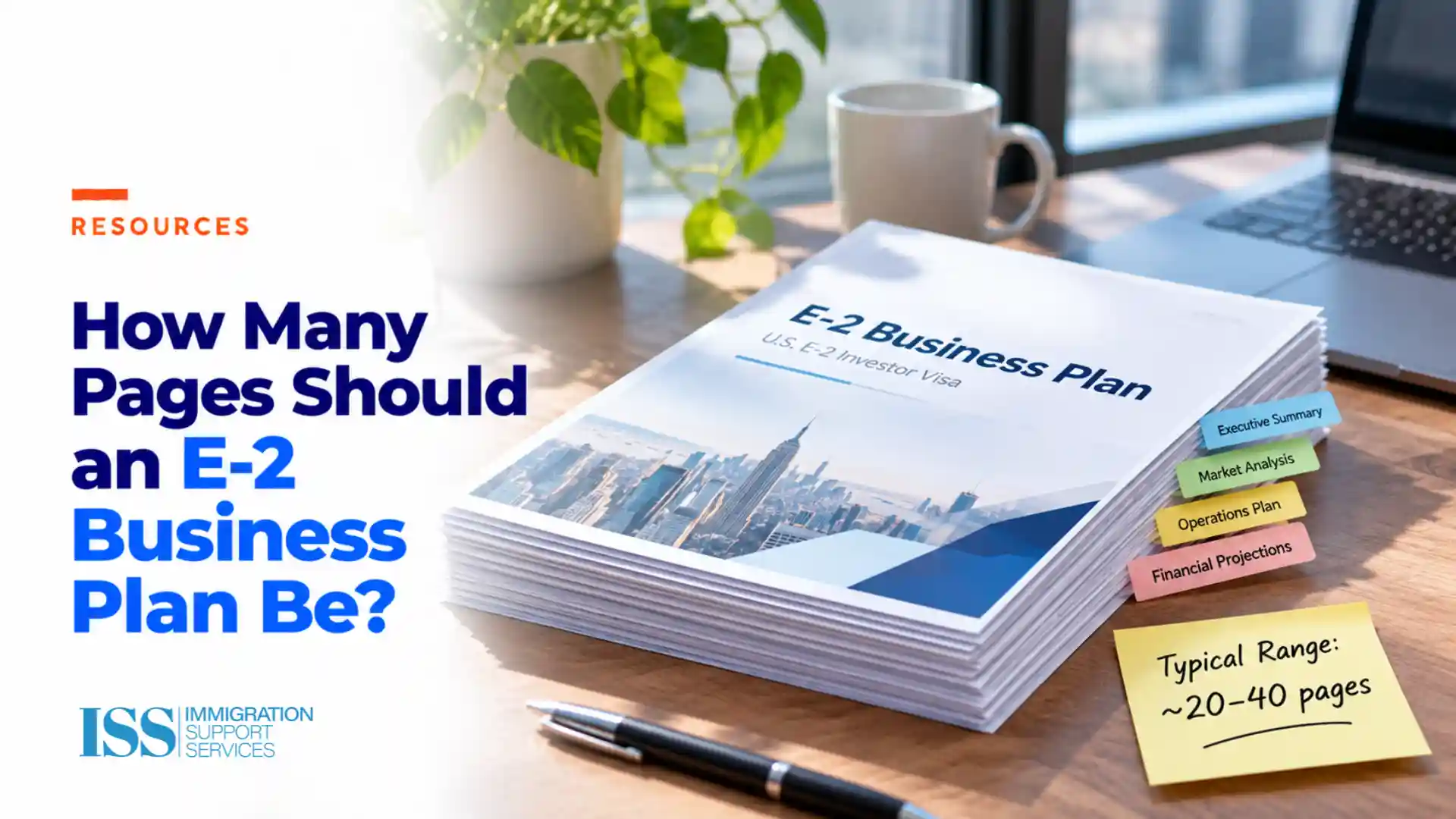
If you’re preparing for an E-2 treaty investor visa, you’ve probably seen advice that ranges from “keep it short” to “the longer the better.” Neither is quite right. There is no official E-2 business plan length, and this article explains what the E-2 rules actually say about business plans (very little about length), what a plan typically needs to cover, why length follows content rather than a target number, and how to think about length in your own situation. It also draws the line between a business-side question (how the plan is written) and a legal question (whether it supports your case), which belongs with your immigration attorney.
The short answer on E-2 business plan length
There is no official page count. The regulations governing E-2 classification (8 CFR 214.2(e) for USCIS and 22 CFR 41.51 for the Department of State) and the Foreign Affairs Manual guidance consular officers use (9 FAM 402.9) don’t set a minimum or maximum number of pages for a business plan. The regulations don’t even expressly require a standalone business plan. The Foreign Affairs Manual identifies a thorough business plan with five-year financial projections as evidence commonly relevant to a new enterprise, and in practice most E-2 applicants with a new or developing business include one.
In practice, immigration business plans often span several dozen pages once financial tables and appendices are included, with the actual length varying by business and by the amount of supporting material. That’s an observation, not a rule. It’s simply the length that tends to result when a plan covers the topics officers are expected to evaluate, in enough depth to be useful, without padding.
A more useful way to think about it: the plan should be as long as it takes to clearly address the elements of the E-2 category that a narrative document can speak to, and no longer.
What the E-2 rules ask an investor to show
To understand why length follows content, it helps to know what the category generally requires. In broad terms, the E-2 classification is available to a national of a country that maintains a qualifying treaty of commerce and navigation with the United States, who has invested (or is actively in the process of investing) a substantial amount of capital in a bona fide enterprise in the U.S., and who is coming to develop and direct that enterprise. These are general descriptions of the law, not an assessment of any particular person’s eligibility.
Two of those elements are where a business plan does most of its work. The first is the “substantial” investment requirement, which the Foreign Affairs Manual describes in proportional terms: the amount invested is weighed against the total cost of purchasing or establishing the type of business in question. The second is the “marginality” rule. Under 9 FAM 402.9-6(E), an enterprise generally may not be marginal, meaning one that lacks the present or future capacity to generate more than enough income to provide a minimal living for the investor and family. The guidance also notes that an enterprise without that present capacity may still qualify if it has the capacity to make a significant economic contribution, and that projected future capacity should generally be realizable within five years after normal business activity begins.
That five-year horizon is the general projection window for the marginality analysis, not a universal rule prescribing every plan’s format. It is, however, why E-2 plans nearly always include multi-year financial projections and staffing plans. A very brief summary may not leave enough room to explain the business model, projections, and staffing plan clearly, or to show how a new business is expected to grow from its starting point.
What a typical E-2 business plan contains
An immigration business plan is structured differently from a plan written for a bank or an investor. It’s organized around the questions an adjudicator is expected to ask. The sections below are what an E-2 plan typically includes, and together they account for most of the page count.
Executive summary and company presentation. Who the business is, what it does, where it operates, its legal structure and ownership, and a short description of the investor’s role. The space needed depends on the business and ownership structure.
Products or services. A clear explanation of what the business sells, how it delivers it, and its pricing approach. The length depends heavily on the business model; a single-service company needs less space than a company with multiple product lines.
Investment breakdown. A detailed accounting of the funds committed to the business, what they were spent on, and what remains to be spent. This section connects directly to the “substantial investment” analysis and is often supported by appendices such as receipts, leases, or equipment invoices referenced in the plan.
Industry analysis and market study. Data on the industry, the local market, the target customer, and demand trends. This is often one of the longer sections because it needs to be grounded in cited sources rather than general statements.
Competition analysis. Who the competitors are and how the business positions itself relative to them.
Marketing and sales plan. How the business intends to reach customers and generate revenue, which supports the credibility of the revenue projections that follow.
Management and personnel plan. The investor’s background, the organizational structure, and the staffing plan, usually including a year-by-year hiring schedule. Hiring projections are one of the ways a plan can help show the enterprise’s capacity to generate more than a minimal living or to make a significant economic contribution, so this section is typically reviewed closely.
Five-year financial projections. Projected income statements, cash flow, and balance sheets, with assumptions explained. Tables take up space, so this section alone can run several pages.
Add these together and a thorough plan naturally reaches a substantial length. If your plan is unusually short, a reasonable question is whether one of these areas is thin. If it’s unusually long, a reasonable question is whether it’s repeating itself or including material that belongs in an appendix.
When a shorter plan makes sense, and when a longer one does
Business type drives length more than any other factor. A business with a simple operating and cost structure may require less explanation than one with multiple locations, products, or revenue streams. A manufacturing operation, a franchise with detailed system requirements, or a business with several revenue streams tends to need more room because there’s more to explain.
The stage of the business matters too. A plan for a business that’s already operating can lean on actual financial results and spend less space on assumptions. A plan for a startup has to justify every projection from scratch, which takes more words and more supporting data.
Appendices are the other variable. Many plans attach supporting documents (resumes, lease summaries, letters of intent, equipment quotes). Appendices can add substantial length, but they’re reference material rather than narrative. When people compare plan lengths, it’s worth asking whether the number includes appendices.
What generally doesn’t help is padding. Repeating the same market statistics in three sections, inserting generic industry boilerplate, or stretching formatting to fill pages makes a plan harder to read without adding anything an officer can evaluate. A concise, well-organized plan is generally easier to review than a longer plan padded with repetitive material.
Length is a business-side question; sufficiency is a legal one
It’s worth being precise about what a business plan is. It’s a supporting document prepared from the information you provide about your business, your investment, and your projections. How it’s written, how it’s organized, and how long it runs are business-side questions.
Whether that plan, together with the rest of your evidence, is enough to support your E-2 application is a legal question. Your licensed immigration attorney evaluates your eligibility, decides what evidence to include, and advises on how the plan fits your overall filing. Your attorney may also have specific preferences about structure, emphasis, or length based on the consulate or office handling your case, and those preferences should guide the plan.
This is how ISS approaches the work. ISS coordinates the business-side services commonly needed in investor and entrepreneur immigration matters, including immigration business plans, business entity registration, and business checking account application assistance, in one place. ISS works alongside your immigration attorney, who remains responsible for all legal strategy and filings; we handle the business-side pieces.
How an ISS immigration business plan is prepared
If you decide to have a plan prepared through ISS, a dedicated ISS coordinator guides you through the process from start to finish. You complete an intake questionnaire and submit your supporting documents, and the plan is prepared by professional business plan writers experienced in immigration-related documentation. The plan is structured in a format commonly used to support E-2, L-1, EB-5, and EB-2 NIW matters, and typically covers company presentation, products and services, management, industry and competition analysis, a market study, a marketing and sales plan, and five-year financial projections.
A first draft is typically ready within 7 to 10 business days after all required documents and the intake questionnaire are submitted. Revisions are unlimited until the design phase, so you and your attorney can adjust emphasis, add detail, or trim sections before the plan is finalized. The length depends on what’s needed to explain your business clearly, not on a fixed template.
You can read more on the Immigration Business Plan service page at immigrationsupportservices.com. If your business entity is not yet formed, you can also review the Business Entity Registration service page. For a broader overview of what an immigration business plan includes, see our related article on what goes into an immigration business plan.
Frequently asked questions about E-2 business plan length
Is there a minimum page count that USCIS or a U.S. consulate requires?
No. Neither 8 CFR 214.2(e), 22 CFR 41.51, nor 9 FAM 402.9 sets a minimum or maximum page count for an E-2 business plan. The rules describe what an investor needs to demonstrate, such as a substantial investment and a non-marginal enterprise, and leave the format of the supporting evidence open.
Does a longer business plan make a stronger E-2 case?
Length by itself is not something the rules evaluate. A plan is useful to the extent it clearly explains the business, the investment, the market, the staffing plan, and the five-year projections. Whether a particular plan, together with your other evidence, is enough to support your case is a legal question for your immigration attorney, not a matter of page count.
Do appendices count toward the length of the plan?
That depends on who’s counting. Supporting documents such as resumes, lease summaries, and equipment quotes are often attached to a plan and can add substantial length, but they’re reference material rather than narrative. When you compare plan lengths or discuss length with your attorney, it helps to be clear about whether appendices are included.
Can I use a business plan I already wrote for a bank loan or an investor?
A plan written for a lender or investor usually answers different questions than an immigration plan. An E-2 plan is organized around the elements an adjudicator is expected to consider, including the investment breakdown, the investor’s role in developing and directing the business, and the five-year projections tied to the marginality analysis. Your attorney can tell you whether an existing plan needs to be adapted or replaced for your filing.
Conclusion
There is no required page count for an E-2 business plan. The regulations and consular guidance describe what an investor needs to demonstrate, and a plan that addresses those elements thoroughly, with real market data, a clear investment breakdown, a staffing plan, and five-year projections, often runs to several dozen pages. Simple businesses may require less explanation, while complex businesses may require more. Padding never helps.
Treat length as the result of a complete, well-organized plan rather than a target. And remember that whether the finished plan supports your case is a question for your immigration attorney, not for the plan writer.
If you’d like help with the business-side pieces of your E-2 preparation, including an immigration business plan, you can schedule a consultation today.
Immigration Support Services Inc. is not a law firm and does not provide legal advice or legal representation. The information in this article is for general educational purposes only. Immigration laws change frequently, and legal questions should be directed to a licensed immigration attorney.