
Immigration Business Plan Process: Drafts, Revisions, and the Design Phase Explained

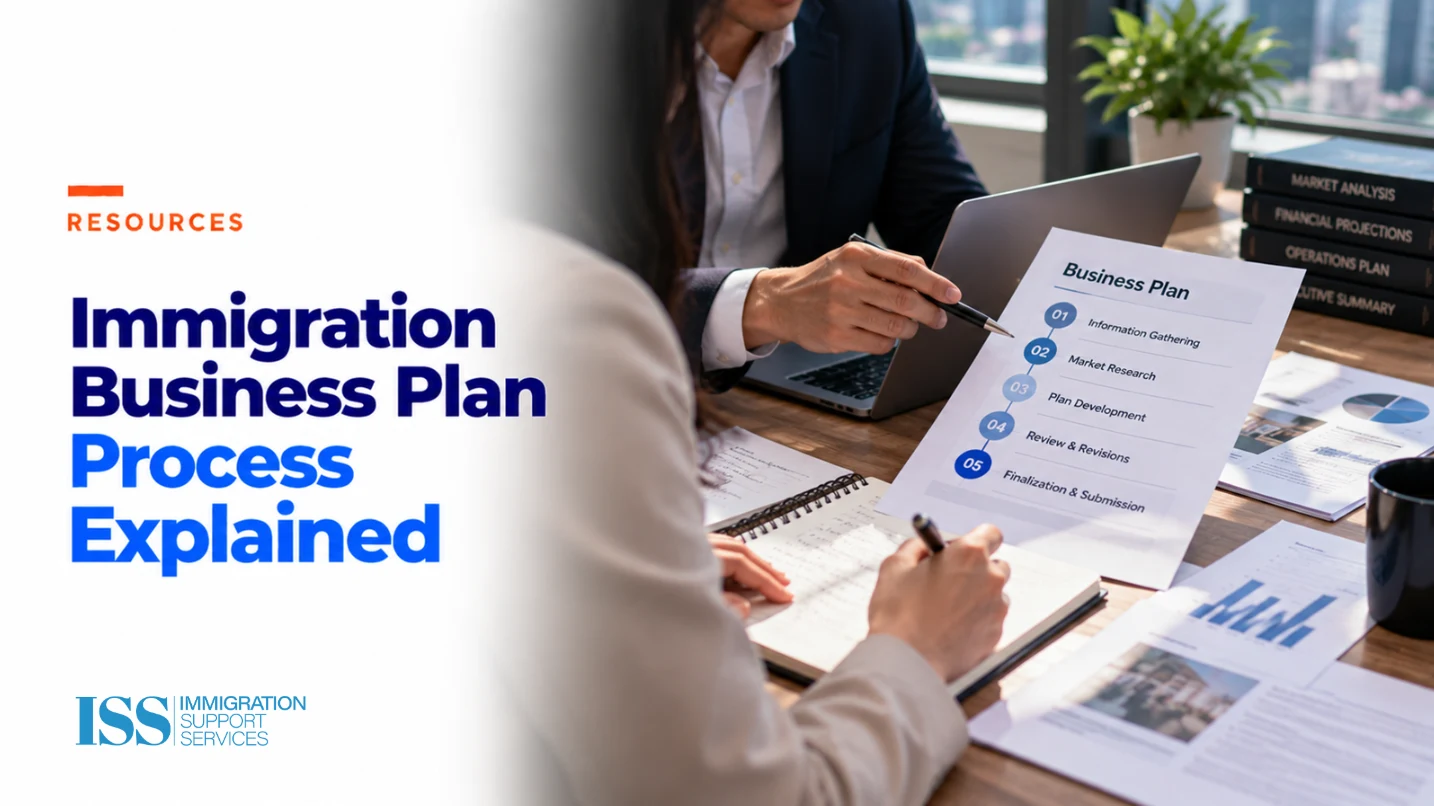
An immigration business plan doesn’t arrive all at once. It moves through a sequence: intake, a first draft, rounds of revision, and a final design phase that turns the approved content into a finished document. Knowing what happens at each stage helps you prepare the right materials, give useful feedback, and understand why the order of the steps matters.
This article walks through how a business plan prepared through Immigration Support Services (ISS) gets from a blank page to a finished document. You’ll learn what the first draft typically contains, how revisions work, what the design phase is and why it marks a natural cutoff for content changes, and how the finished plan fits into the larger immigration matter your attorney is handling.
Why an immigration business plan is built in stages
A business plan written for an immigration matter does two jobs at once. It describes a real business in enough detail that a reader can understand what the company does, who runs it, and how it expects to make money. It also presents that information in a format commonly used to support E-2, L-1, EB-5, and EB-2 NIW matters, which means the structure and level of detail tend to follow established conventions.
Building the plan in stages keeps those two jobs from getting in each other’s way. The early stages focus on getting the facts and the narrative right. The last stage focuses on presentation. Mixing the two, say redesigning page layouts while the financial projections are still changing, creates rework and introduces errors. A staged process keeps the content settled before the formatting begins.
Whether any plan meets the requirements of a particular visa category is a legal question for you and your licensed immigration attorney. ISS works alongside your attorney, who remains responsible for all legal strategy and filings; ISS handles the business-side pieces.
Stage one: intake and document collection
Everything starts with information you provide. When you sign on for a business plan through ISS, you receive an intake questionnaire covering your background, the business concept, ownership, the products or services, your target market, staffing expectations, and your financial assumptions. You’ll also be asked for supporting documents, which can include things like a résumé, evidence of funds, purchase agreements if they exist, and any existing financial records.
This is the stage where you have the most influence over the quality of the first draft. Vague answers produce vague drafts. Specific answers, such as realistic pricing, concrete hiring plans, and a clear description of what the business actually sells, give the writers something solid to work with.
The first draft is typically delivered within 7 to 10 business days after you submit all required documents and the completed intake questionnaire. That timeline depends on the intake being complete, so an incomplete questionnaire or missing documents will push it out. Your dedicated ISS coordinator guides you through the process from start to finish, including letting you know what is still outstanding.
Stage two: the first draft
The first draft is prepared by professional business plan writers through ISS, working from the information you supplied. It’s typically a complete document rather than an outline. A business plan prepared through ISS typically includes the following sections:
- A company presentation describing the business, its legal structure, location, and purpose
- A products and services section
- A management section covering the people running the company and their relevant experience
- An industry and competition analysis
- A market study describing the customers the business expects to serve
- A marketing and sales plan
- Five-year financial projections, including revenue, expenses, staffing costs, and profitability assumptions
These sections reflect what the ISS deliverable typically covers. What any particular immigration filing actually requires varies by category and by the facts of the case, and that’s a question for your attorney.
The first draft is meant to be reviewed, not accepted as final. The draft may contain assumptions or information that needs clarification, and those are important points to check. Read it as if you were explaining your own business to someone who has never heard of it. Where the draft says something you wouldn’t say, that’s a revision note.
What to look for when reviewing a first draft
Start with the facts. Confirm that names, ownership percentages, addresses, dates, and dollar figures match your actual plans. Then look at the narrative: does the description of the business match what you intend to do, and are the projections based on assumptions you can stand behind? Finally, consider whether anything important is missing, such as a key supplier relationship or a planned second location.
It also helps to share the draft with your immigration attorney at this stage. Your attorney may have views on what the plan should emphasize given the strategy they’re pursuing, and it’s far easier to incorporate that input during revisions than after the document is designed.
Stage three: revisions
Revisions are the back-and-forth that turns a first draft into a plan you’re comfortable with. Business plans prepared through ISS include unlimited revisions until the design phase, so you’re not limited to a fixed number of rounds while the content is still being worked out.
A revision round usually works like this. You send consolidated feedback to your coordinator, the writers make the changes, and you receive an updated draft. Clear, consolidated feedback helps the writers process your requested changes and reduces conflicting instructions, so it’s worth gathering all of your notes before sending them.
Common kinds of revision requests
Most revision requests fall into a few categories. Factual corrections fix details that were wrong or outdated. Narrative changes adjust tone, emphasis, or the explanation of how the business works. Financial adjustments change assumptions in the projections, such as pricing, salaries, or the timing of hires. Structural additions add a section or expand one that was too thin.
Financial adjustments deserve special care. Changing one number in a five-year projection often changes many others, because revenue, expenses, staffing, and profit are linked. If you ask for a change to the hiring schedule, expect the payroll figures, the expense totals, and the net income lines to shift with it. That’s normal and is a sign the projections are internally consistent.
Attorney input during revisions
If your attorney has comments, the revision stage is the time to incorporate them. Attorneys often want certain points stated more explicitly, or want a section reorganized to track the way they intend to present the case. ISS does not evaluate whether a plan satisfies any legal standard; that judgment belongs to your attorney. ISS can coordinate the attorney’s requested changes with the business plan writers.
Stage four: the design phase
Once you confirm the content is final, the plan moves into the design phase. This is where the approved text and financial tables are laid out in the finished format: consistent typography, charts and graphs for the financial data, formatted tables, page headers, and a cover. The goal is a document that reads cleanly and presents the financial information visually as well as numerically.
The design phase is the natural cutoff for content revisions, and there’s a practical reason for that. Design work is built on top of settled content. Rewriting a paragraph after layout can reflow pages, break chart references, and require the financial graphics to be regenerated. Unlimited revisions apply up to the start of this phase precisely because changes afterward involve rebuilding finished work. Revisions requested after the design phase begins are handled under the terms of your ISS agreement, and your coordinator can explain how that works before you sign off on the content.
How to know you are ready for design
Before you approve the content for design, run through a short checklist. Have you read the full draft, not just the sections you were most interested in? Has your attorney reviewed it, if they wanted to? Are the financial assumptions ones you can explain if asked? Are the company details included in the plan, such as the entity name and ownership structure, consistent with your current business records and your attorney’s filing strategy? If the answer to any of these is no, it’s better to take one more revision round than to approve prematurely.
Stage five: delivery and what happens next
After design, you receive the finished plan. From there, the document goes to your attorney, who decides how and whether to use it as part of the filing. ISS does not prepare or file immigration forms or petitions and does not represent anyone before USCIS or any other agency, so the plan’s role in your case is entirely in your attorney’s hands.
Many clients coordinate the business plan with other business-side pieces at the same time. If the plan includes entity details, such as the company name or state of formation, those details should match your current business records and the approach your attorney is taking; whether and when an entity needs to be formed depends on the immigration category and your facts, which is a question for your attorney. If the plan references a business checking account or operating funds, the account application may be running in parallel. ISS coordinates these business-side services, business plan, entity registration, and business checking account application assistance, in one place.
Practical tips for a smoother process
A few habits make the drafting and revision process go more smoothly. Complete the intake questionnaire thoroughly before submitting it, even if some answers are estimates, because the first-draft timeline starts only once everything is in. Keep one person as the point of contact for feedback so that revision notes don’t conflict. Loop in your attorney early rather than at the end. And if your plan will include entity details, settle them with your attorney before drafting, since a name change or ownership change late in the process touches nearly every section.
Finally, treat the plan as a description of a real business rather than a document written to fit a template. The writers prepare the plan from the information you provide, and the most useful plans are the ones grounded in decisions you’ve actually made.
Frequently asked questions
-
- How long does the first draft take?
- The first draft is typically delivered within 7 to 10 business days after you submit all required documents and the completed intake questionnaire. The clock starts when the intake is complete, so missing documents or unanswered questionnaire items will extend the timeline.
-
- How many revisions can I request?
- Business plans prepared through ISS include unlimited revisions until the design phase. Once the content is approved and design begins, further changes are handled under the terms of your ISS agreement, and your coordinator can explain those terms before you sign off.
-
- What exactly is the design phase?
- The design phase is the final step, where the approved text and financial tables are laid out in the finished format with consistent typography, charts, formatted tables, and a cover. Because the design is built on settled content, it marks the natural cutoff for content revisions.
-
- Can my attorney request changes to the plan?
- Yes. Many clients share the draft with their attorney during the revision stage, and ISS can coordinate the attorney’s requested changes with the business plan writers. Your attorney remains responsible for all legal strategy and filings.
-
- Does ISS decide whether my plan meets the requirements for my visa category?
- No. ISS is not a law firm and does not evaluate whether a plan satisfies any legal standard. Whether a plan meets the requirements of a particular immigration category is a question for you and your licensed immigration attorney.
Conclusion
A business plan gets finished through a deliberate sequence: intake, a first draft, as many content revisions as it takes, and then a design phase that turns the approved content into the final document. Each stage has a purpose, and the order protects the quality of the finished product. Understanding where you are in that sequence, and what’s expected of you at each point, is the best way to keep the process moving.
If you’re preparing for a business or investment immigration matter and want to talk through how the business plan process works, you can schedule a consultation at immigrationsupportservices.com/schedule/. Your dedicated ISS coordinator can walk you through intake, timelines, and how the plan fits alongside the other business-side pieces. Legal questions about your eligibility, visa category, or strategy should go to a licensed immigration attorney.
Immigration Support Services Inc. is not a law firm and does not provide legal advice or legal representation. The information in this article is for general educational purposes only. Immigration laws change frequently, and legal questions should be directed to a licensed immigration attorney.